
εUCG
How we can help...
Find out more...

εUCG Process
Learn more about theεUCG process

Latest Project
See where the εUCG technology is applied today...
Why Ergo Exergy?
We are the only source...
Who can gain from
εUCG?
Find out how εUCG can help your business prosper...

εUCG & Power Generation
The εUCG™ gas can be used to generate electricity in a number of different power plants. It can be used as fuel in gas turbines, gas engines or steam turbines. The gas can be used as a sole fuel or as part of a fuel blend with natural gas, industrial gases, distillate, and pulverized coal. In each case, inclusion of the gas in the fuel mix may require some modification of combustion systems.
Ergo Exergy has substantial experience in using εUCG gas in co-firing applications.
The most efficient and cost-effective way to
generate electricity from εUCG
gas is via the use of a gas turbine combined-cycle plant.
The gas turbine can provide some or all of the compressed
air needed by the εUCG process,
and achieve higher power outputs on the eUCG gas than on natural
gas (NG). An IGCC plant using εUCG
for gas production is called an εUCG-IGCC
plant.
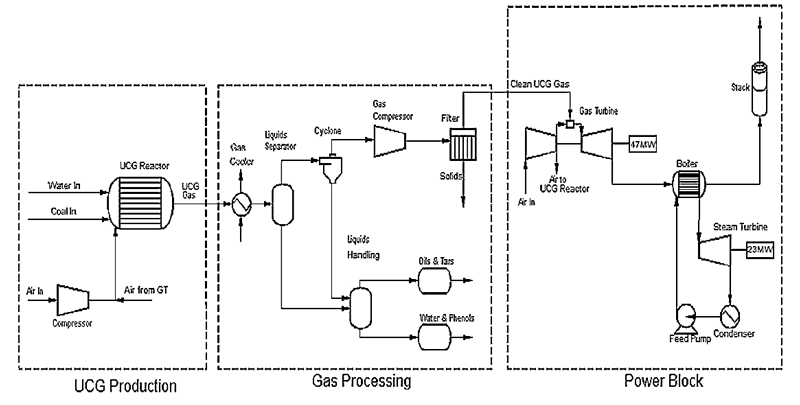
Conceptual Design of the εUCG-IGCC plant
It is economically feasible to remove contaminants such as particulates, ammonia and hydrogen sulphide, from the εUCG gas so that turbine exhaust gases contain very little pollutants. The high efficiency of the εUCG process and the combined-cycle configuration also means that CO2 emissions are lower than virtually all other coal-based power generation technologies. It is also feasible to remove the CO2 from the εUCG gas before it is used in the gas turbine and permanently store it in the highly-permeable zone left around a depleted gasifier, reducing CO2 emission rates to less than those of a natural gas combined-cycle.
The εUCG-IGCC
demonstrates CO2 emissions of about 25% lower than a supercritical
boiler plant. At 673 kg/MWh, these emissions are still higher
than the emissions of a combined-cycle gas turbine fueled
by natural gas. However, the εUCG-IGCC
with CO2 sequestration produces only 333 kg/MWh, providing
significant reduction against the NGCC plant.
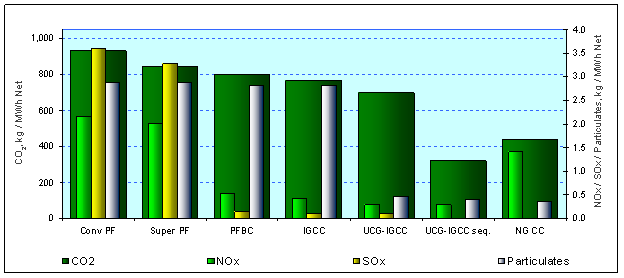
Air Emissions from Conventional Fossil Fuel Power
Plants
and εUCG-IGCC
Cost estimates for Canadian conditions are as follows:
At C$799/kW installed, εUCG-IGCC is lower in capital cost than any coal-based plant and is just above the capital cost of an NG CC. The εUCG-IGCC shows the lowest cost for electricity (C$19/MWh), consistent with the results of feasibility studies conducted elsewhere. It is important to note the incremental cost of CO2 capture and sequestration. The εUCG-IGCC with pre-combustion CO2 capture and subsequent sequestration in the underground cavities will produce electricity at the cost of C$24/MWh, representing as little as a 26% increase in cost. The results show that εUCG-IGCC with CO2 sequestration is very cost-competitive.
A wide range of gas turbines can be used for εUCG-IGCC applications. Turbines using εUCG gas will demonstrate an increase in output by up to 25% when compared to those using natural gas. The power block efficiency reaches 55%, while the overall efficiency of the UCG-IGCC process can reach 43%.
A εUCG-IGCC power plant will generate electricity at a much lower cost than an existing or proposed fossil fuel power plant. The CO2 emissions of the plant can be reduced to a level that is 55% less than those of a supercritical coal-fired plant, and 25% less than the emissions of NGCC.
Simply put, εUCG gas is
an ideal fuel for power generation in GTCC configuration because:
- It gives a 25% increase in the gas turbine power output compared to natural gas.
- It produces fewer air emissions: greenhouse gas emissions can be as much as 30% less than natural gas.
- The cost of electricity produced from εUCG gas is much less than with natural gas.
- εUCG gas can be produced in abundance for years to come and used to fuel GTCC plants in areas without any natural gas supply.